Lancasterian
School Room
_ _ _ _ _ _ _
The Lancasterian School Room was built in 1813 by public subscription, money donated by the good people of Farnley to be held in Trust through the ages for local people.
The building is unique and it belongs to all of us.
Managed by a small group of Trustees, its primary function was to promote the education of the poor. Over the years it has also been a venue for social, health and well-being activities.
A place to come together and celebrate.
We welcome all ideas that will enrich the lives of local people.
Come and join us – as a volunteer, a Trustee, a provider of workshop activities, events or clubs for all ages.
We can’t wait to meet you!
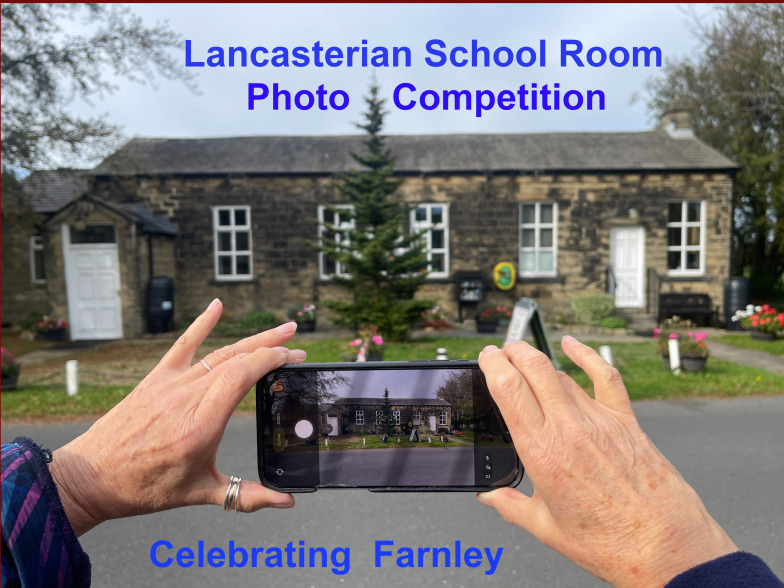
Photo competition instructions
Celebrating Farnley through the Lense of your mobile phone! Farnley has a rich past, lots of ancient woodland, characterful buildings, great views and lovely people. This is a call out for photographs that capture this special community. At least 12 of your finest offerings will be featured in our 2027 calendar.
How to enter: Get your coat on, go out and get snapping or trawl through your photo library.
Where to send your entries: by email to lancasterianschoolroom@gmail.com
Deadline: Monday 16th November.
A Short History of The Lancasterian School Room at Moor Top
On 3 February 1809 Joseph Lancaster arrived in Leeds to explain his system to the people of the town. Hundreds flocked to the Music Hall in Albion Street to hear him. The press were deeply divided on the subject with the Leeds Intelligencer condemning Lancaster's "deep laid schemes" arguing that "the poor should be educated as they hitherto have been. " The Leeds Mercury however responded with "The generous design of bettering the conditions of the labouring classes, by giving instruction to their children, gains in every part of the empire, in spite of the puny efforts of ignorance , craft and bigotry."
Lancaster impressed the majority of his Albion Street audience and by the end of the year a school for boys had been established in the old Assembly Rooms in Kirkgate. In 1812 the boys moved into a new building on Alfred Street and a Girls school opened at the Kirkgate site. These were to be followed by Lancasterian schools in School Street and Rockingham Street.
It was at about this time that funds were raised by public subscription to build a chapel of ease that could also be used as a school at Moor Top. Moor Top at that time comprised of approximately 17 dwellings with various trades including farming and hand loom weaving. The school would be run on Lancasterian principles and the building opened in 1813. Unfortunately it seems that the School Room records of this period have been lost but we can build a picture of how the school was run by examining the Leeds Lancasterian School's rules and annual reports. All children were expected to attend church or chapel, on Sundays they had to report to school at half past nine and half past one in order to be escorted by a monitor to their place of worship. If they failed to attend a letter was sent the following day to their parents to demand an explanation for their absence. (1)
During the week, school began at nine in the morning and one in the afternoon. Children were expected to arrive 'with clean hands and face,' hair cut short and combed, and with clean shoes'. They were to arrive and depart in a quiet and orderly fashion and 'to avoid the company of bad boys, avoid 'quarrelling and contention' and to use 'no ill words or names.'
Children were also obliged 'to observe the orders and regulations of the school, to pay proper respect to the master in all his comands' and the monitors who had been appointed. Parents of the pupils were requested to ensure that their children were prevented from 'playing in the streets and fields on the Sabbath-day'. Children not conforming to these regulations or playing truant were liable to be expelled.
The curriculum was simple. Teaching the alphabet was fundamental, and younger children were given a tray of sand, the monitor demonstrated the shape of the letters and children copied them either with their finger or a piece of wire. Once that had been mastered the children moved into the second class when a whole word was dictated and traced in the sand. It was only the higher classes that benefited from slates and copybooks. It was an efficient system that kept costs down. Several generations of children from Farnley attended the school. Meanwhile the farming community of the village radically transformed when rich deposits of coal, ironstone and fireclay were discovered under the estate of William Armitage of Farnley Hall. Parliament passed an Education Bill in 1870 allowing councils to hold elections to establish School Boards which in turn issued in bigger schools that better met the need of scholars. The Lancasterian School Room fell into disrepair and for a time the building was empty but In 1875 the present small building of millstone grit was built by public subscription to replace the original one. In 1877 it became a Sunday School offering both morning and afternoon sessions and a Church of England mission room. The building has been used by the local community for a variety of purposes and remains administered by a group of trustees since that day.
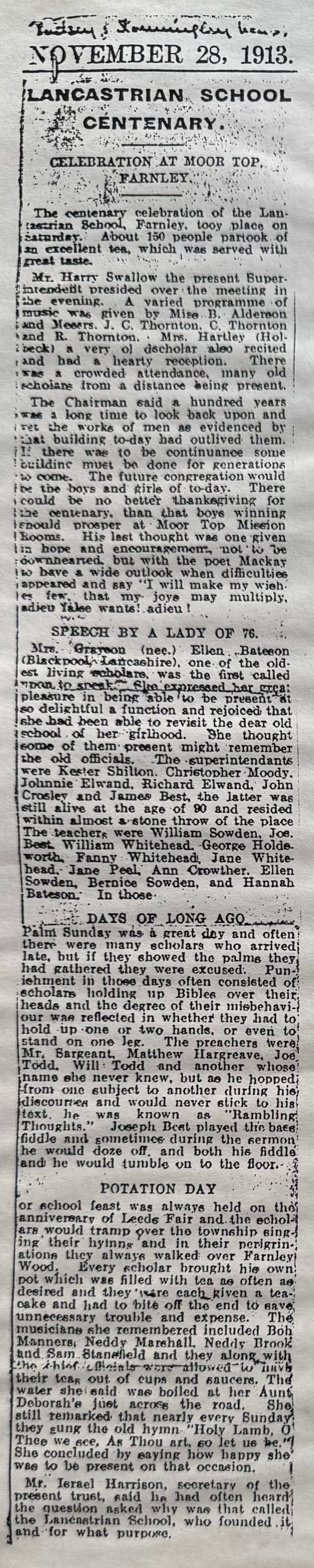
In 1913 the people of Farnley celebrated the centenary of the old building and on the 28th of November the Pudsey and Staningley News devoted two full columns of it's board sheet to the event which featured the memories of several old pupils.
Lancasterian School Room
1913 Centenary